By Kachi Okezie, Esq
It’s fairly settled, though sadly so, that overvaluing paper qualifications has distorted public judgment, weakened democratic accountability, and distracted citizens from governance outcomes on Nigeria.
Nigeria is one of the few countries where a politician can preside over economic collapse, mass unemployment, institutional decay, industrial-scale corruption, worsening insecurity and democratic backsliding — yet the fiercest national argument will revolve around whether another politician graduated with a first class or a third class degree.
That contradiction captures the tragedy of Nigerian political culture more clearly than any statistic ever could.
The recent obsession with Peter Obi’s third-class degree is not truly about education. It is about selective morality, political convenience and a deeply distorted national understanding of leadership. It reflects a society that has dangerously confused certificates with competence, credentials with character, and academic symbolism with actual governance capacity.
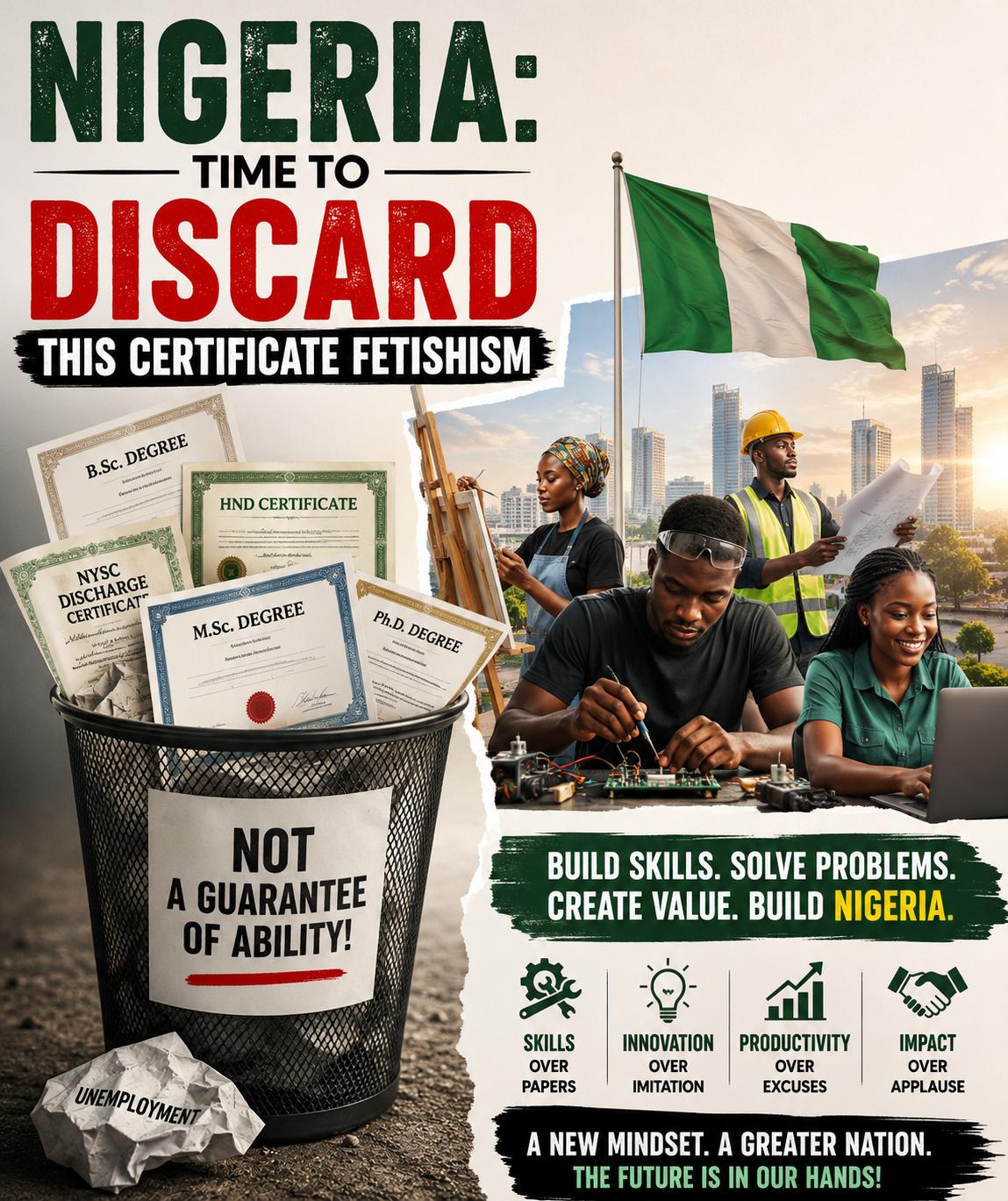
Nigeria’s over-emphasis on paper qualifications has become one of the most misleading features of its public life.
For decades, Nigerians have been conditioned to treat certificates almost as sacred objects; magical indicators of wisdom, integrity and leadership ability. Political campaigns proudly advertise degrees, titles and foreign universities as though governance were an academic competition rather than a test of judgment, discipline and statecraft. Public discourse routinely elevates résumés above results.
Yet Nigeria’s post-independence history exposes the emptiness of this obsession.
The country has never lacked educated leaders. Nigeria’s ruling class is overflowing with lawyers, professors, economists, technocrats, MBAs, SANs and foreign-trained elites with polished credentials and impressive biographies. It was once claimed during the Jonathan years (2011-2015) that Nigeria probably had more PhDs than England and Wales combined.
Still, the nation remains trapped in underdevelopment, corruption, institutional weakness and chronic governance failure. The vast academic laurels didn’t appear to translate to felt development or visible transformation. That reality alone should have forced a national rethink long ago.
Instead, Nigerians continue to cling to credential fetishism as though certificates themselves build economies, secure communities or create functional institutions. They do not. A framed degree on a wall has never repaired a broken healthcare system. Academic titles do not automatically produce fiscal discipline, moral courage or administrative competence. Some of the worst governments in history were managed by highly educated men.
The irony is glaring. For years, millions defended Muhammadu Buhari against criticism surrounding his academic records by insisting that leadership was about “integrity,” “discipline,” and “patriotism,” not certificates. Nigerians were repeatedly told that a man did not need polished academic credentials to govern effectively. The same society then watched the emergence of Bola Ahmed Tinubu, a politician whose biography has remained surrounded by unusual opacity for decades; disputed records, conflicting narratives, unanswered questions and unresolved controversies that would trigger relentless scrutiny in many mature democracies. Yet much of the political establishment have closed ranks around him.
Then suddenly, a third-class degree became a national emergency. The hypocrisy is breathtaking.
Nobody genuinely believes that the classification of a university degree obtained decades ago is the decisive measure of leadership capacity. If academic credentials alone guaranteed national success, Nigeria should already resemble one of the world’s most efficiently governed countries because its elite class is among the most credentialed in Africa.
But governance is not an examination hall. The British example exposes this contradiction with uncomfortable clarity. John Major left school at sixteen and never attended university, yet rose to become Prime Minister and presided over economic growth while helping lay the foundations for the Northern Ireland peace process. Winston Churchill never obtained a university degree either, yet became one of the defining wartime leaders of the twentieth century. Britain has repeatedly produced leaders without elite academic pedigrees because British political culture, at its best, historically understood something Nigeria still struggles to grasp: leadership is ultimately tested through judgment, courage, coalition-building, communication, institutional stewardship and measurable outcomes; not through framed certificates.
This does not mean education is unimportant. Far from it. Serious societies should value intellectual preparation and informed leadership. But mature democracies understand the difference between valuing education and worshipping credentials. They understand that a degree is a tool, not a sacrament.
Nigeria has blurred that distinction disastrously. The country’s unhealthy fixation on certificates has created a political culture where appearances often matter more than performance. Citizens are encouraged to debate transcripts instead of tax policy, degree classifications instead of institutional reform, and academic prestige instead of governance outcomes. Political propaganda thrives in this environment because symbolism becomes easier to market than competence.
Meanwhile, the deeper issues destroying national life receive insufficient attention: collapsing productivity, weak institutions, judicial compromise, failing infrastructure, unemployment, insecurity, inflation and the erosion of public trust.
What Britain possesses that Nigeria still struggles to build is not simply better leaders. It possesses stronger institutions and a more mature political culture. Churchill and Major operated within systems capable of constraining excess, preserving continuity and protecting state functionality beyond individual personalities. Parliament mattered. Institutions retained memory. The civil service endured. Loyalty was to the state, not an individual. Governance was not reduced to the mythology of individual men.
Nigeria, by contrast, has evolved into a republic of personalities and credentials. Politics is increasingly tribalised, emotionalised and reduced to propaganda warfare where public perception matters more than administrative substance. Citizens are pushed into shallow binaries: our saviour versus their enemy (hailers versus wailers). In that atmosphere, standards become elastic and facts become partisan weapons.
That is why one politician’s missing records are dismissed as irrelevant while another politician’s decades-old academic classification becomes grounds for ridicule. It is not really about education. It is about power, selective outrage and political convenience. It’s also about rank hypocrisy.
And this is where the Nigerian elite has been especially dishonest. The same class that lectures citizens about meritocracy routinely thrives on patronage, godfatherism, ethnic bargaining and elite protection networks. The same establishment that suddenly invokes academic excellence to attack opponents has repeatedly normalised opacity, mediocrity and impunity whenever politically expedient.
Ordinary Nigerians often understand this contradiction better than the elite itself. A trader who successfully runs a business for twenty years understands management, risk and accountability in practical ways many overcredentialed bureaucrats never will. A governor who improves schools, infrastructure, security and fiscal discipline demonstrates more leadership than a polished intellectual who governs through slogans and media optics. That is because competence reveals itself through outcomes.
The tragedy is that Nigeria rarely sustains political conversations at that level. Instead of asking difficult questions about economic philosophy, productivity, institutional reform, public-sector efficiency or constitutional restructuring, public debate repeatedly collapses into shallow symbolism and personality worship. Meanwhile, the country burns.
Nigeria urgently needs to outgrow its dangerous obsession with certificates and paper qualifications. Education should matter, but it should never become a substitute for accountability, competence or measurable performance. A serious society judges leaders not merely by what they studied decades ago, but by what they have built, how they think, the institutions they strengthen and the lives they improve.
The relevant question is not whether a leader graduated with a first class, second class or third class degree. The relevant question is whether that leader possesses the discipline, vision, competence and moral seriousness required to govern a deeply fractured nation responsibly.
Until Nigerians learn to apply those standards consistently, regardless of tribe, party or political loyalty, the country will remain trapped in cycles of selective outrage, elite manipulation and perpetual disappointment.
And the republic of certificates will continue producing governments that look impressive on paper while failing catastrophically in reality.