By Godson Azu
President Bola Ahmed Tinubu’s acceptance of an invitation from His Majesty King Charles III to undertake a State Visit to the United Kingdom from Wednesday, 18th March to Thursday, 19th March 2026, represents more than a ceremonial milestone. It is a moment layered with historical resonance, strategic calculation, and symbolic diplomacy—one that signals a renewed phase in the long and complex relationship between Nigeria and the United Kingdom.
Notably, this visit will be the first formal state visit by a Nigerian president to the UK in 37 years, the last occurring in 1989. In diplomatic terms, such a gap is significant. State visits are the highest form of bilateral engagement between nations, reserved for partners with whom deep political, economic, and cultural bonds either exist or are being deliberately strengthened. That Nigeria is being accorded this level of honour underscores its continued relevance as Africa’s largest economy, most populous nation, and a key geopolitical actor.
The Symbolism of Windsor Castle
Buckingham Palace’s confirmation that King Charles III and Queen Camilla will host President Tinubu and First Lady Senator Oluremi Tinubu at Windsor Castle adds an additional layer of symbolism. Windsor Castle, one of the oldest continuously occupied royal residences in the world, is not merely a venue; it is a statement of tradition, continuity, and prestige.
State visits at this level typically involve a full ceremonial welcome, a state banquet, and structured engagements between the visiting delegation and senior British officials. These rituals matter. They communicate respect, recognition, and strategic intent. For Nigeria, being received in this manner sends a powerful message to the international community: that the country remains a valued partner in global diplomacy.
Beyond Ceremony: Strategic Substance
While pomp and pageantry draw public attention, the true significance of this visit lies in its policy and economic underpinnings. Nigeria and the UK already share extensive ties in trade, investment, education, security cooperation, and people-to-people exchanges. However, both countries now face changing global realities—economic uncertainty, shifting alliances, and the need to adapt to new technological and geopolitical landscapes.
For President Tinubu, who has embarked on an ambitious reform agenda aimed at economic diversification, fiscal restructuring, and attracting foreign direct investment, the visit offers a platform to deepen investor confidence and reposition Nigeria as a competitive destination for global capital. High-level discussions are expected to touch on:
• Expanding bilateral trade and investment flows
• Energy transition and sustainable development
• Security cooperation and counterterrorism
• Climate change and environmental resilience
• Education, skills development, and technology transfer
The Diaspora Dimension: People-to-People Diplomacy
An often underappreciated pillar of Nigeria–UK relations is the Nigerian diaspora community. The United Kingdom hosts one of the largest populations of Nigerian professionals in the diaspora—across medicine, law, finance, academia, technology, creative industries, and public service. These individuals function as informal ambassadors, bridging both societies and contributing significantly to the economies of both nations.
There is therefore growing hope that this state visit will create space for President Tinubu to engage with representatives of the Nigerian diaspora in the UK. Such an interaction would not only recognise their contributions but also signal a renewed commitment to harnessing diaspora expertise, investment, and networks in Nigeria’s national development agenda.
Continuity in a Changing Monarchy
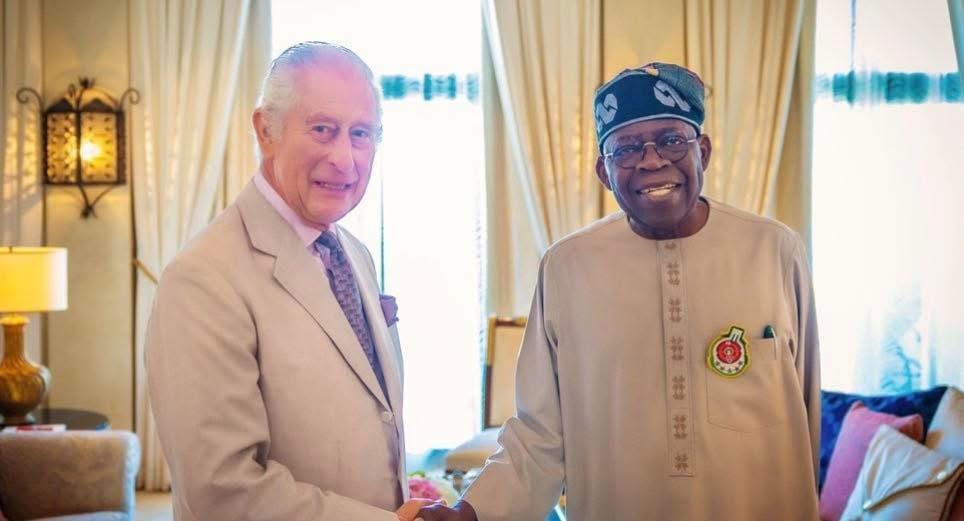
President Tinubu has previously met King Charles III, including at a reception following his inauguration. However, this state visit marks the highest level of royal hospitality under the new reign. It also reflects continuity in British diplomatic tradition: regardless of changes in monarch or government, long-standing partnerships are preserved and periodically renewed through symbolic acts.
In this sense, the visit represents not only a personal engagement between two leaders but also an institutional reaffirmation of Nigeria–UK relations.
A Moment of Recalibration
The timing of the visit is particularly important. Nigeria is navigating domestic economic adjustments, while the UK is redefining its global posture. Both countries have incentives to explore new models of cooperation that move beyond historical patterns toward more balanced, mutually beneficial partnerships.
This recalibration is likely to emphasise private sector-led growth, innovation, and long-term investment rather than dependency-driven engagement. If managed strategically, the visit could become a turning point—shifting Nigeria–UK relations from largely symbolic cordiality to deeper, outcome-driven collaboration.
Reinforcing a Longstanding Friendship
At its core, this state visit is a reminder that diplomacy is as much about relationships as it is about policies. The enduring historical, cultural, and human connections between Nigerians and Britons continue to shape the trajectory of bilateral ties.
As President Tinubu and the First Lady prepare to be hosted by King Charles III and Queen Camilla, Nigeria stands at a moment of renewed international visibility. The visit promises to reinforce a longstanding friendship, while also opening new chapters in trade, diplomacy, and strategic cooperation.
History will ultimately judge the success of this engagement not by the elegance of the ceremonies, but by the tangible outcomes it produces. Yet, as a symbolic and strategic milestone, the 2026 State Visit already stands as a significant marker in the evolving story of Nigeria–United Kingdom relations.