By Godson Azu
The establishment of the South East Development Commission (SEDC) was celebrated across the South East as a historic opportunity to address decades of infrastructural neglect, economic stagnation, youth unemployment, and the developmental challenges confronting the region.
For many, the Commission represented a long-awaited vehicle for regional renewal, economic empowerment, industrial revival, and strategic federal intervention.
Barely into its existence, however, the Commission now finds itself at the centre of a major Senate investigation over allegations of questionable expenditures, financial discrepancies, and accountability concerns involving billions of naira of public funds.
The question that many citizens across the South East are now asking is simple:
Has the South East Development Commission begun to fulfil its mandate, or is it already becoming another public institution consumed by the culture of waste, opacity, and elite patronage?
The ₦16 Billion Question
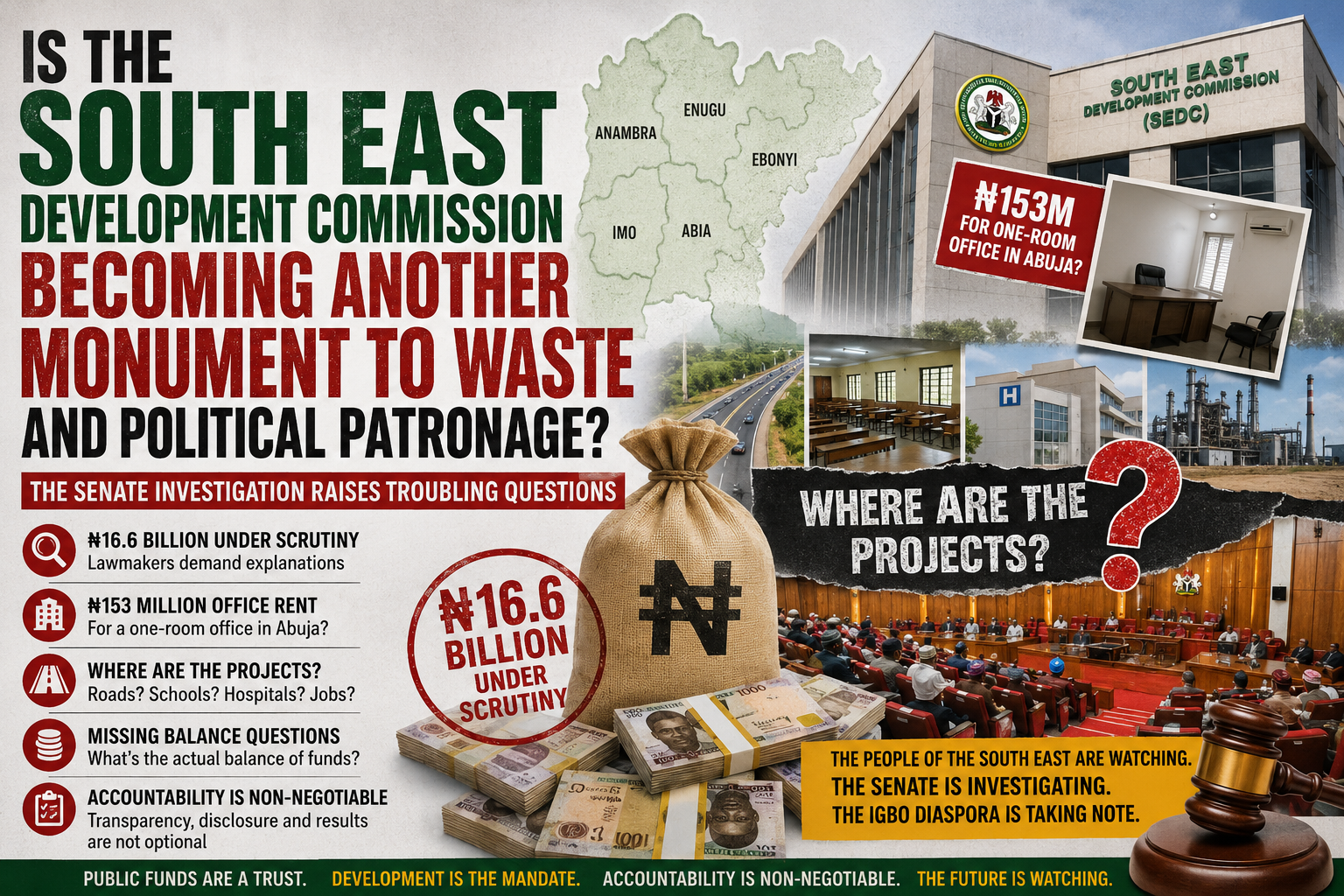
During the recent Senate Committee hearing on the activities of the Commission, lawmakers reportedly demanded explanations regarding approximately ₦16.6 billion released to the agency.
Rather than hearing detailed accounts of completed roads, industrial parks, agricultural projects, skills acquisition centres, youth empowerment programmes, educational interventions, healthcare facilities, or other visible developmental achievements across the South East, the public was confronted with disturbing questions about financial management and expenditure patterns.
The Senate Committee raised concerns regarding the utilisation of the funds and reportedly questioned discrepancies between financial figures presented by the management of the Commission and information available to the Committee from other official sources.
The issue goes beyond accounting figures.
The fundamental question is:
What exactly has the South East received from the billions already allocated to the Commission?
The Controversial ₦153 Million Office Rent
Perhaps the most shocking revelation from the Senate hearing was the reported payment of approximately ₦153 million for what lawmakers described as a one-room office accommodation in Abuja.
For millions of South Easterners struggling with economic hardship, unemployment, poor roads, insecurity, and declining infrastructure, the figure immediately triggered public outrage.
Citizens are asking:
- What kind of office attracts such expenditure?
- Was due procurement process followed?
- Was value for money achieved?
- Who approved the expenditure?
- Was competitive bidding undertaken?
- Was the payment independently evaluated before approval?
Most importantly:
How does a ₦153 million office rental contribute directly to the development of the South East?
Until convincing answers are provided, public skepticism will remain.
The Missing Balance Questions
Another issue emerging from the Senate hearing concerns the apparent discrepancies surrounding the balance of funds reportedly held by the Commission.
Lawmakers reportedly challenged explanations provided by management regarding the amount remaining from allocations already released.
If billions of naira have been allocated and significant portions spent, the public deserves a transparent and verifiable breakdown of:
- Amounts received;
- Amounts committed;
- Amounts spent;
- Outstanding obligations;
- Current balances;
- Projects funded;
- Contractors engaged;
- Procurement processes followed.
This is not an unreasonable demand.
The funds belong to the Nigerian people.
The Commission merely acts as a trustee.
Where Are the Projects?
Perhaps the most important question remains unanswered:
What tangible projects have been completed by the South East Development Commission since its establishment?
Across:
- Abia State,
- Anambra State,
- Ebonyi State,
- Enugu State,
- Imo State,
citizens deserve to know:
- Which roads have been completed?
- Which schools have been renovated?
- Which hospitals have been upgraded?
- Which industries have been supported?
- Which communities have received development projects?
- Which youth empowerment programmes have been successfully implemented?
- How many jobs have been created?
- What measurable impact has been achieved?
Development commissions should be judged by outcomes, not announcements.
By completed projects, not press releases.
By impact, not expenditure.
If billions have been spent, the evidence should be visible on the ground.
A Dangerous Pattern?
Nigeria has witnessed similar trajectories before.
Agencies created with noble intentions often begin with enormous public goodwill, only to become embroiled in allegations of wasteful spending, administrative excesses, questionable contracts, and endless investigations.
The South East Development Commission was created to avoid these failures, not replicate them.
The region cannot afford another intervention agency that consumes resources without producing measurable development.
The South East has too many pressing challenges:
- Collapsing federal roads;
- Youth unemployment;
- Industrial decline;
- Infrastructure deficits;
- Insecurity;
- Energy shortages;
- Brain drain.
Every naira allocated to the Commission should therefore be treated as a sacred trust.
Accountability Must Prevail
The Senate investigation should not be viewed as an attack on the Commission.
Rather, it represents a constitutional responsibility to ensure accountability in the management of public resources.
The leadership of the Commission must now rise above politics and provide comprehensive answers.
The people of the South East deserve:
- Full disclosure of all expenditures;
- Publication of project locations;
- Publication of contract awards;
- Independent audits;
- Transparent procurement records;
- Detailed financial statements.
Anything less would undermine public confidence in the institution.
Conclusion
The South East Development Commission was created to become an engine of development, not a symbol of controversy.
The ongoing Senate investigation has raised serious questions about financial management, expenditure priorities, and accountability within the Commission.
The burden now rests squarely on the Commission’s leadership to demonstrate that public funds have been utilised responsibly and that meaningful development is taking place across the region.
Until citizens can clearly see where the billions have gone, what projects have been completed, and how lives have been improved, the questions raised by the Senate will continue to resonate across the South East.
The South East people are watching.
The Senate is investigating.
The Igbo’s In diaspora is taking notes.