
By Godson Azu
Politics, in every democratic society, is fundamentally about the people — their trust, expectations, representation, accountability, and the responsibility entrusted to elected leaders. In the United Kingdom today, the growing political turbulence surrounding Prime Minister Keir Starmer and the governing Labour Party appears to reflect a deeper national frustration about governance, economic hardship, public confidence, and the future direction of British politics.
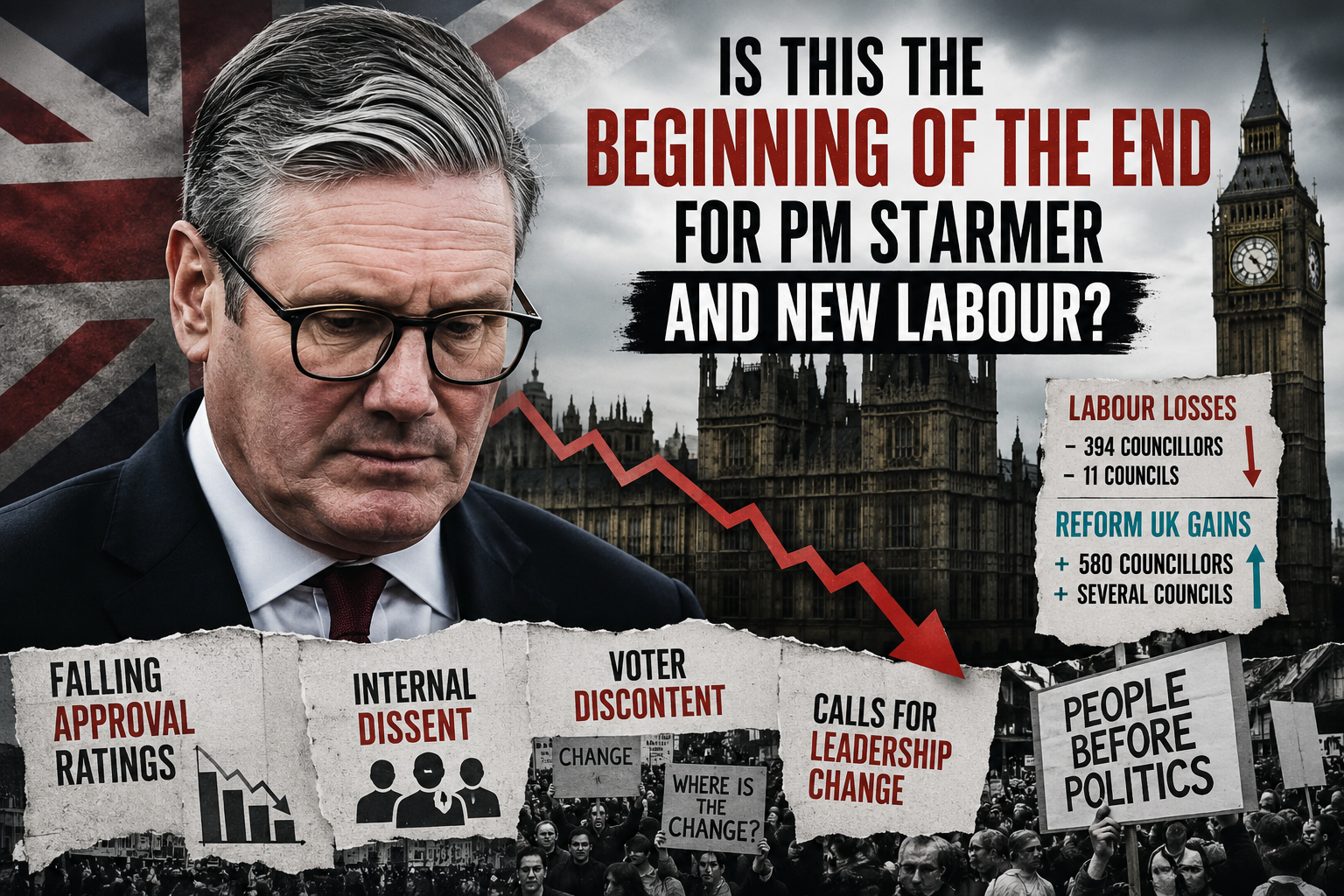
The continuing decline in public approval ratings, Labour’s significant setbacks in the 2026 local council elections, rising internal party dissent, and increasing calls for leadership change have created what many political observers now describe as one of the most difficult periods of Starmer’s premiership since Labour’s landslide victory in the 2024 General Election.
Recent local elections across England delivered a major political shock. Labour reportedly lost hundreds of councillors and several council authorities, while Reform UK emerged as one of the biggest beneficiaries of voter dissatisfaction. According to election analysis published by LocalGov UK, Labour lost approximately 394 councillors and 11 councils, while Reform UK gained more than 580 councillors and secured control of several councils for the first time in its history.
The implications of these losses go beyond ordinary local political setbacks. Local elections in Britain are often regarded as a referendum on the sitting government. They reveal the mood of the electorate and frequently foreshadow future parliamentary shifts. Political analysts argue that the 2026 results exposed not only dissatisfaction with Labour’s policy direction, but also a growing fragmentation of the traditional two-party political structure that dominated British politics for decades.
Prime Minister Starmer has remained publicly defiant amid mounting criticism. Following the election results, he stated:
“The results are tough, they are very tough, and there’s no sugarcoating it.”
Despite admitting responsibility for Labour’s electoral losses, Starmer insisted he would not resign, arguing that his government still possesses a democratic mandate from the electorate following the 2024 General Election victory.
However, inside Labour ranks, political tensions continue to escalate. Reports indicate that several Labour MPs, cabinet ministers, and party officials have openly questioned Starmer’s leadership and electoral viability. Reuters recently described the situation as a “political crisis,” noting that Labour members increasingly fear the Prime Minister lacks a clear ideological direction capable of reconnecting with voters.
The resignation of junior ministers and calls for what some described as an “orderly transition” within the party have intensified speculation about Starmer’s long-term survival as Labour leader.
This political moment raises important constitutional and democratic questions:
- Can a governing party maintain legitimacy when public trust rapidly deteriorates?
- How long can internal party loyalty survive electoral humiliation?
- Is Britain entering a new age of fragmented, multi-party politics?
- Could public anger over inflation, immigration, taxation, public services, and economic stagnation permanently alter Labour’s political fortunes?
The broader national environment also contributes significantly to Labour’s challenges. Britain continues to face economic pressures linked to inflation, cost-of-living concerns, NHS waiting lists, industrial tensions, immigration debates, housing shortages, and national security anxieties. Analysts suggest that many voters expected quicker and more visible improvements following Labour’s return to power after years of Conservative rule.
Instead, sections of the electorate increasingly perceive government policies as cautious, slow-moving, and disconnected from everyday realities. Public frustration has allowed opposition parties, particularly Reform UK, the Liberal Democrats, and the Green Party, to gain momentum among different voter demographics.
Political commentator and historian Professor Tim Bale observed that Labour’s internal ideological divisions remain unresolved, especially between centrist and left-wing factions. This internal conflict mirrors historical patterns previously experienced by both Labour and Conservative governments during periods of declining popularity.
The political danger for Starmer is not merely electoral losses; it is the perception of weakened authority. In politics, perception often becomes reality. Once party members begin openly discussing leadership succession, political instability can rapidly accelerate.
The rise of Reform UK under Nigel Farage has added further pressure to Britain’s political establishment. Farage described recent results as a “historic change in British politics,” reflecting a growing appetite among voters for anti-establishment alternatives.
This shift may indicate the beginning of a broader political realignment in the United Kingdom — one where traditional party loyalties weaken, voter volatility increases, and coalition-style political competition becomes more common.
The timing is also politically sensitive as the government prepares for upcoming parliamentary sessions and further legislative debates following the King’s Speech. In Westminster politics, the King’s Speech traditionally outlines the government’s legislative priorities and national agenda. Yet, a weakened leadership facing internal rebellion may struggle to maintain political discipline and public confidence necessary to drive ambitious reforms through Parliament.
Britain therefore appears to stand at a critical political crossroads.
The coming months may determine whether:
- Starmer successfully stabilises his leadership and rebuilds public confidence;
- Labour undergoes internal restructuring or leadership transition;
- opposition parties continue gaining electoral ground;
- or Britain enters a prolonged period of political uncertainty and fragmented governance.
History reminds us that British politics can change rapidly and unexpectedly. Former Prime Ministers including Theresa May, Boris Johnson, Liz Truss, and Rishi Sunak all faced varying forms of internal rebellion, public backlash, and political collapse within relatively short periods.
Whether Keir Starmer survives this political storm remains uncertain. What is clear, however, is that British politics is entering a new and highly unpredictable chapter — one defined by voter impatience, rising populism, weakened party loyalty, economic anxiety, and growing demands for accountability and responsible governance.
This is politics.
This is people’s representation.
This is accountability and responsibility.
And perhaps, history may eventually judge whether this moment was truly the beginning of the end for PM Starmer and New Labour.
Mazi. Godson. Azu is a UK based International Relations and Politics Expert, Commentator, and Consultant.