
A Crucible for Labour, the Conservatives, and the Rise of Reform UK
By Mazi Godson Azu
Director, CM Centre for Leadership and Good Governance (UK)
UK-based International Relations and Politics Expert. The Convener of Annual London Political Summit and Awards.
Introduction: A Democratic Stress Test
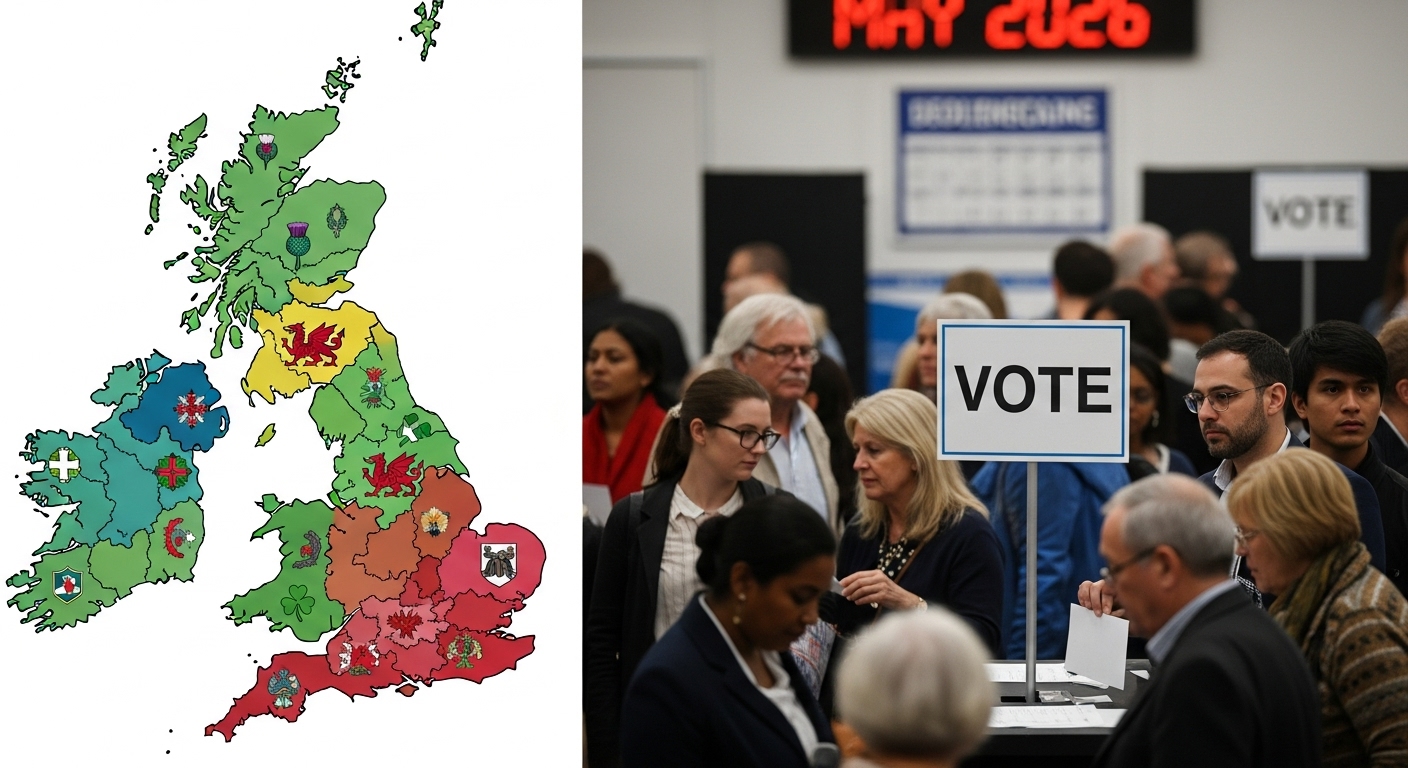
As the United Kingdom approaches the May 2026 local elections, it faces one of the most consequential democratic tests of the post-Brexit era. The elections will take place against the backdrop of accelerating devolution of powers, renewed demands for regional autonomy, intensifying debates over electoral system reform, and the disruptive rise of Reform UK.
Far from being routine local contests, the May 2026 elections will function as a mid-term referendum on governance, representation, and political legitimacy, testing Labour’s devolution agenda, the Conservatives’ capacity for recovery, and Reform UK’s ability to transition from protest politics to credible local governance.
Devolution of Power: From Westminster Centralism to Regional Authority
The UK’s constitutional architecture has long been characterised by extreme centralisation, particularly in England. While Scotland, Wales, and Northern Ireland operate devolved legislatures, English local authorities historically functioned with limited fiscal autonomy and policy discretion.
Recent government initiatives mark a decisive shift. Labour’s devolution programme seeks to:
- Transfer meaningful powers over transport, housing, skills, planning, and local economic development to regional authorities
- Expand the authority of combined mayoral administrations
- Rationalise local government through unitary authority reforms
The stated aim is to rebalance the state, reduce regional inequality, and move decision-making closer to communities. In principle, this reflects international best practice: strong local governance enhances democratic responsiveness and economic efficiency.
However, implementation has proven politically sensitive.
Regional Autonomy vs Democratic Accountability
The restructuring of councils and expansion of mayoral powers has coincided with the postponement of several local elections, justified by the government as necessary to avoid administrative disruption during reorganisation.
Critics argue that delaying elections—without renewed mandates—weakens democratic legitimacy, particularly in areas experiencing economic stress and political volatility. The concern is not merely procedural but political: postponements risk reinforcing public perceptions that elites manipulate democratic timelines for strategic advantage.
As the May 2026 elections approach, voters will judge whether devolution has genuinely empowered communities—or merely rearranged authority while diluting accountability.
Electoral System Reform: The FPTP Problem in a Multi-Party Britain
At the heart of current democratic tensions lies the First Past the Post (FPTP) electoral system used in English local elections.
In an increasingly fragmented political landscape, FPTP:
- Produces disproportionate outcomes
- Rewards geographically concentrated support
- Penalises emerging and smaller parties—or inflates them unpredictably
The rise of Reform UK has exposed these distortions sharply. In recent local elections, Reform translated relatively modest vote shares into significant seat gains in some councils, while large portions of the electorate remained effectively unrepresented.
By contrast, Single Transferable Vote (STV)—used in Scotland and Northern Ireland—better reflects voter preferences and encourages coalition-building rather than polarisation. As multi-party politics becomes the norm rather than the exception, pressure for electoral reform is likely to intensify after May 2026.
The Rise of Reform UK: From Protest to Power
Reform UK’s rapid ascent reflects deep voter disillusionment with traditional parties. Drawing support from:
- Former Conservative voters frustrated by post-Brexit economic stagnation
- Disaffected Labour voters in deindustrialised regions
- Anti-establishment sentiment cutting across class and geography
Reform has positioned itself as an insurgent force against what it frames as a disconnected political elite.
The May 2026 local elections represent a critical inflection point for Reform UK:
• Can it demonstrate competence in council leadership and service delivery?
• Can it govern responsibly rather than merely mobilise protest votes?
• Can it sustain momentum beyond grievance-based politics?
Local governance will test whether Reform can evolve from disruption to durability.
Labour’s Test: Devolution in Practice
For Labour, now governing nationally, the May 2026 elections are the first major electoral stress test of its reform agenda.
Voters will assess:
- Whether devolution has delivered visible improvements in housing, transport, and local economies
- Whether regional leaders possess genuine autonomy or remain fiscally constrained
- Whether Labour has balanced structural reform with democratic accountability
Failure to deliver tangible benefits risks alienating precisely the voters Labour must retain in former industrial heartlands now contested by Reform UK.
The Conservatives: Identity, Recovery, or Decline
The Conservative Party enters the May 2026 elections in a weakened and uncertain state. Having lost its traditional monopoly on centre-right voters, it faces existential questions:
• Can it reconnect with voters drawn to Reform’s populist message?
• Can it articulate a coherent vision on devolution and local governance?
• Or will it continue to haemorrhage support in suburban and post-industrial England?
Local elections often act as early warning systems. For the Conservatives, May 2026 may reveal whether recovery is plausible—or whether fragmentation on the right has become structural.
Why May 2026 Matters
The May 2026 local elections will test three foundational pillars of UK democracy:
- Governance – Can devolved institutions deliver results, not just rhetoric?
- Representation – Does the electoral system still reflect voter intent in a multi-party era?
- Political Adaptation – Can established parties respond meaningfully to public discontent, or will insurgent forces fill the vacuum?
These elections will shape not only council chambers but the strategic direction of national politics heading toward the next general election.
Conclusion: A Turning Point for British Democracy
The United Kingdom stands at a democratic crossroads. Devolution offers an opportunity to renew trust, rebalance power, and reconnect citizens with governance. But without transparency, accountability, and fair representation, reform risks becoming another elite-managed process detached from public consent.
The May 2026 local elections will reveal whether devolution strengthens democracy—or merely redistributes authority within a system already under strain.
For Labour, the Conservatives, and Reform UK alike, the message from voters will be unmistakable: deliver locally, represent fairly, or face political realignment.