By Godson Azu
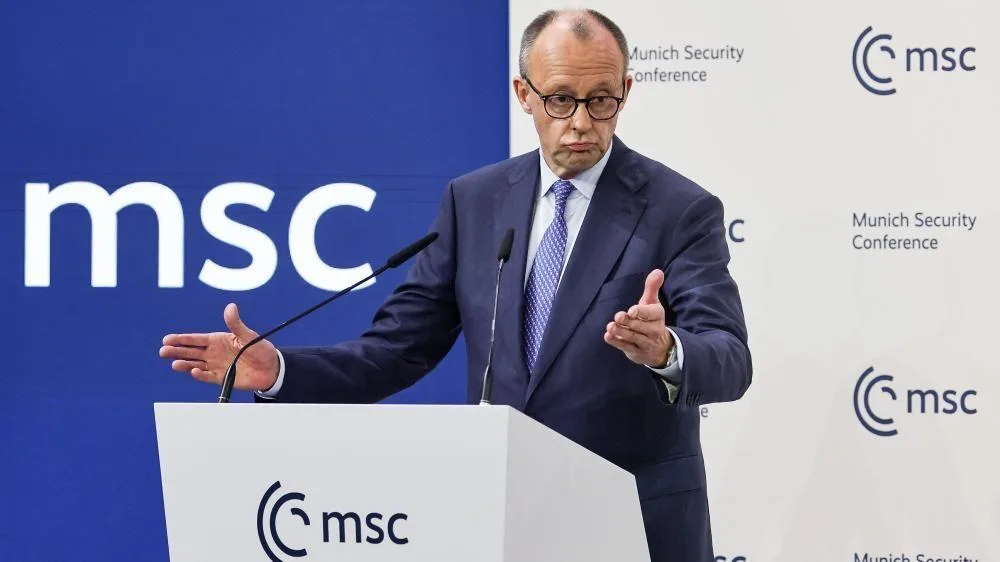
At the 2026 Munich Security Conference in Munich (13 February 2026), German Chancellor Friedrich Merz delivered a striking assessment of the current global landscape — declaring that the post–Cold War rules-based international order that Western democracies had relied on for decades has effectively ended, and that the world is transitioning into an era dominated by great-power politics and direct power competition.
Merz’s Key Statement on the Rules-Based Order
In his opening address, Merz stated unequivocally:
“Die regelbasierte internationale Ordnung, so unvollkommen sie selbst zu ihren besten Zeiten war, gibt es so nicht mehr.”
(“The rules-based international order — as imperfect as it was even in its best days — does not exist in this form anymore.”)
— Friedrich Merz at the Munich Security Conference, 13 February 2026. 
This phrase has become a central quote in international discussions — signaling a break from the idea that global affairs can primarily be managed through international law, treaties, institutions, and norms alone.
According to Merz:
• The world has crossed into a new era shaped by great powers where freedom and security are no longer guaranteed merely by international rules. 
• Traditional elements of the rules-based international system — such as diplomatic restraint, collective security via alliances, and legal norms — are being overtaken by direct strategic competition and military force. 
What Does “Great-Power Politics” Mean in This Context?
Merz described a geopolitical environment marked by:
• Russia’s unprovoked war in Ukraine, which he called the starkest expression of the breakdown of the old order — where force is used to reshape borders rather than diplomacy. 
• China’s growing global ambitions, with Beijing challenging the status quo and increasingly shaping international norms and power balances. 
• A United States whose global leadership and strategic focus have shifted, meaning the old Western-led order no longer works as it once did. 
He said:
“…we have crossed the threshold into a time that is once again openly shaped by power and great-power politics.”
— Friedrich Merz (paraphrased from speech transcript). 
Europe’s Role in This New System
Merz did not simply diagnose a problem — he also advocated a strategy:
• Strengthen Europe’s own defense and strategic autonomy, particularly within NATO, to reduce dependence on external powers. 
• Build credible deterrence and increase military readiness amid a fractured world order. 
In his view, Europe must adapt to the realities of geopolitics instead of clinging to the idea that rules and institutions alone will preserve peace.
What Analysts are saying About This Shift
Scholars and commentators are echoing the sentiment:
• Some , including myself argue that the rules-based order was always an aspirational concept rather than a fully realized system, and that current geopolitical competition merely reveals its limits. 
• Others describe today’s world as entering a phase where power and influence matter more than shared rules, particularly with rising powers like China and renewed Russian assertiveness. 
Implications for Global Politics
Merz’s framing reflects a consensus among many Western policymakers that:
• The optimism of the post–Cold War era is fading.
• Alliances and partnerships must now contend with realpolitik which is the hard reality of competing national interests and strategic rivalry.
• Europe must adjust its role, balancing cooperation with key partners, the U.S mostly importantly, while expanding its own capabilities.
The world is changing and it’s changing very fast with time.