By Godson Azu
UK-Based International Relations and Political Analyst
Introduction
Democratic governance rests not only on elections but also on symbols of collective legitimacy. Flags, coats of arms, parliamentary seals, and party emblems are not decorative objects; they represent constitutional authority, national unity, and the sovereignty of citizens.
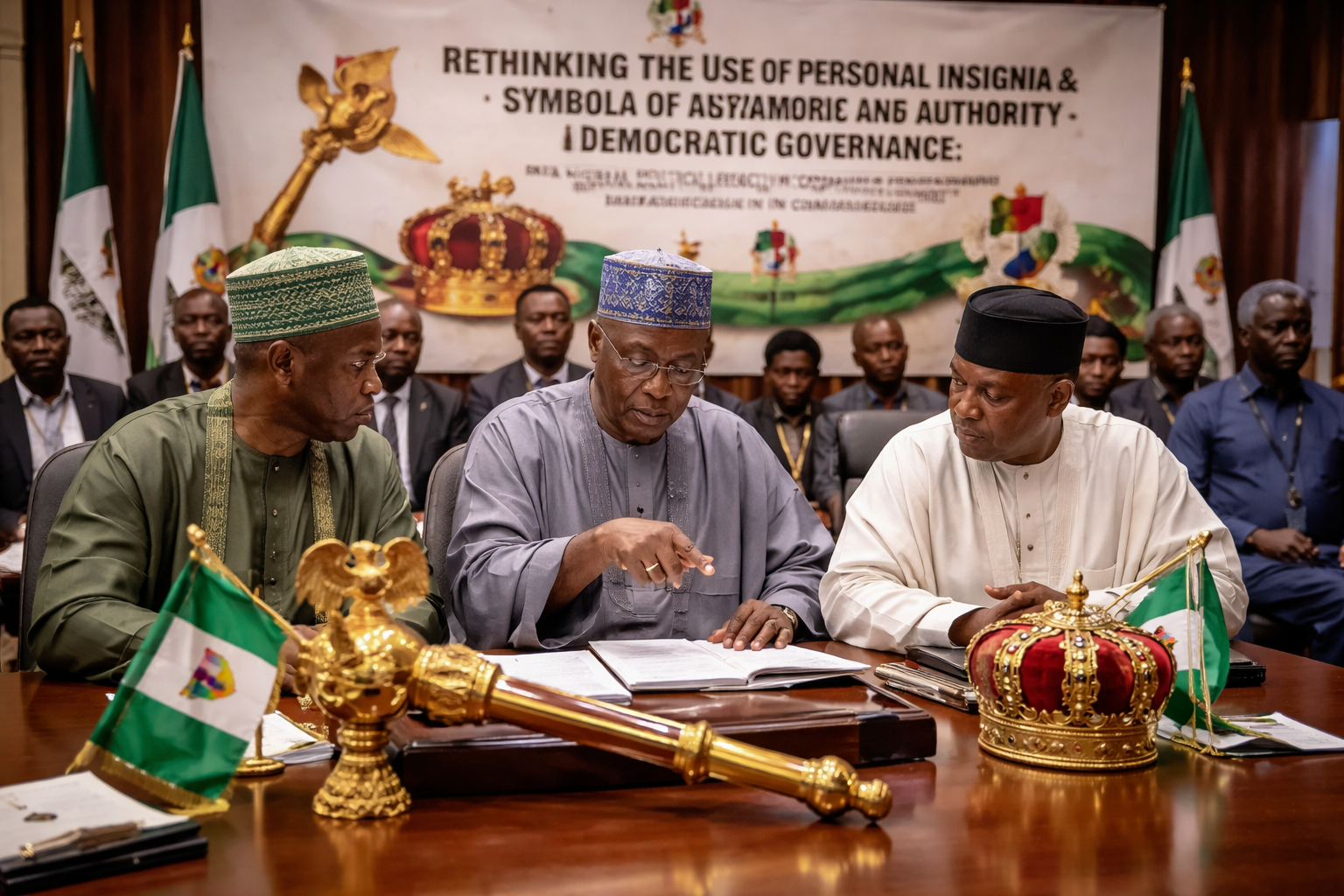
In recent years, Nigeria’s political space has witnessed an increasing visibility of personal insignia, hand signals, and individualized symbols of authority used by elected officials and their supporters — sometimes appearing to rival or overshadow official party symbols and state emblems.
As a political analyst and concerned citizen, my position is neither hostile to political branding nor dismissive of personal political identity. However, I argue that once an individual assumes public office through democratic election and oath-taking, the continued dominance of personal insignia risks creating:
• selective identity representation,
• perceived exclusion,
• institutional ambiguity, and
• symbolic personalization of state authority.
Democracy requires that elected leaders transition from party champions to custodians of the entire polity.
The Democratic Transformation After Election
Political theorists such as Max Weber emphasized that modern states derive legitimacy from legal-rational authority, not personal charisma. Similarly, Jean-Jacques Rousseau’s concept of the “general will” suggests that elected leaders must represent collective sovereignty rather than factional interests.
Once sworn into office — whether as:
• Local Government Chairman,
• Legislator,
• Governor, or
• President
an office holder ceases to represent only party supporters and becomes a constitutional representative of all citizens, irrespective of political affiliation.
This transition is symbolically expressed through the prioritization of:
• national emblems,
• institutional insignia,
• parliamentary identity, and
• constitutional symbols of office.
Where personal symbols dominate official imagery, governance risks appearing personalized rather than institutionalized.
Nigeria’s Legal Framework: Electoral Act and Constitutional Context
- Electoral Law and Party Symbols
Under Nigeria’s electoral regulatory framework (consistent with provisions historically contained in the Electoral Act and INEC regulations):
Political party symbols must:
• be registered with the Independent National Electoral Commission (INEC),
• remain unique and non-offensive,
• avoid religious, ethnic, or governmental authority imagery,
• serve as the official identifier on ballots and campaign materials.
INEC legally recognizes only registered party logos, not personal gestures, slogans, or individualized political insignia.
Therefore:
✔ Party logos — legally recognized
⚠ Personal symbols — politically tolerated but legally unofficial
The law regulates electoral competition, not personality branding.
- Constitutional Principles (1999 Constitution of Nigeria)
Sections 221–229 of the Constitution emphasize that political parties must possess:
• national character,
• non-sectarian identity,
• non-religious and non-ethnic foundations.
While the Constitution does not explicitly prohibit personal political symbols, it strongly discourages identities that may promote division or exclusion.
The constitutional spirit therefore favors institutional neutrality over personal symbolism.
The Emerging Nigerian Concern
Recent public discourse has revealed confusion between:
• personal insignia associated with political leaders,
• official party symbols (such as those of the APC or other parties),
• and symbols representing the Nigerian state itself.
This symbolic overlap may unintentionally reinforce perceptions of:
• political exclusivity,
• personality cult politics,
• or selective belonging within governance structures.
Nigeria’s democracy, still consolidating after decades of military rule, benefits more from strong institutions than strong personalities.
As political scientist Samuel Huntington argued in Political Order in Changing Societies, institutionalization — not personalization — determines democratic stability.
Comparative International Practices
Examining other democracies provides important context.
United Kingdom
In the United Kingdom:
• Prime Ministers campaign under party symbols (Conservative, Labour, Liberal Democrats).
• Once in office, official communications primarily feature the Royal Coat of Arms and institutional branding of HM Government.
Neither Margaret Thatcher, Tony Blair, nor Rishi Sunak governed using personal insignia as state identity markers.
Government authority remains visibly institutional, not personal.
United States
American presidents maintain strong personal branding during campaigns. However:
• official presidential communication uses the Seal of the President of the United States, not campaign imagery.
• The White House, federal agencies, and military institutions avoid campaign symbolism after inauguration.
Even highly personalized political figures transition symbolically into institutional roles upon assuming office.
European Union Democracies
Across Germany, France, and Nordic states:
• state symbolism strictly separates party politics from governance.
• Presidents and Prime Ministers operate under constitutional seals and national flags.
In Germany, for example, the Bundesadler (Federal Eagle) represents state authority — never a leader’s personal identity.
African Democratic Examples
Ghana provides a notable comparison:
• Campaigns prominently use party symbols (NPP elephant, NDC umbrella).
• Once elected, presidents govern primarily under national symbols and state protocol imagery.
Similarly, Botswana and South Africa emphasize institutional symbolism to reinforce post-apartheid inclusiveness and national unity.
Why Symbolism Matters in Fragile Democracies
Political symbolism influences public psychology.
Research in democratic consolidation shows that excessive personalization of authority can:
• weaken institutional trust,
• deepen partisan divisions,
• blur boundaries between state and individual leadership,
• encourage loyalty to personalities rather than constitutional systems.
Nigeria’s historical experience with centralized authority makes symbolic neutrality particularly important.
Legal Reality vs Moral Responsibility
Legally:
• Personal political signals are not explicitly illegal unless offensive or discriminatory.
• Electoral law primarily regulates party symbols during elections.
Morally and democratically, however, elected leaders bear a higher responsibility.
Leadership requires symbolic humility — an acknowledgment that public office belongs to the people, not the individual.
Policy Recommendations
1. Institutional Symbol Priority
• Official government events should prioritize national and constitutional insignia.
2. Post-Election Symbolic Transition
• Political branding should reduce significantly after swearing-in ceremonies.
3. INEC Advisory Guidelines
• Develop soft regulatory guidance clarifying distinctions between party identity and governance symbolism.
4. Civic Education
• Promote public understanding of institutional symbols as expressions of shared citizenship.
5. Political Party Codes of Conduct
• Encourage internal rules limiting excessive personalization once candidates assume office.
Conclusion
Nigeria’s democratic evolution depends not only on credible elections but also on the symbols through which authority is expressed.
Personal insignia may mobilize supporters during campaigns, but governance demands broader legitimacy. An elected official becomes the representative of both supporters and critics — majority and minority alike.
The strength of a democracy lies in citizens recognizing the state before recognizing the individual leader.
Nigeria’s future stability will be better secured when institutions — not personalities — remain the primary symbols of power.
I write as a concerned citizen open to correction, dialogue, and constructive democratic engagement.
Godson Azu
International Relations and Politics Analyst
United Kingdom