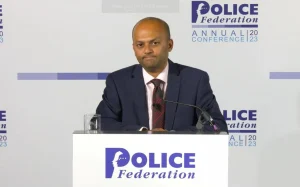

By Kachi Okezie, Esq
To FIFA.
To UEFA.
To CAF.
To every affiliated federation, league, and disciplinary committee operating under your authority:
The era of symbolic gestures is over.
For decades, racism has poisoned the global game while governing bodies have responded with fines so trivial they are absorbed as operational costs. Empty-stadium orders. Partial closures. Token campaigns. Slogans. Meanwhile, the abuse continues — in stadiums, online, and within club cultures that have never been meaningfully compelled to change.
This is no longer a public relations issue. It is a governance failure. And governance failures invite litigation, arrests and prosecution. FIFA should know. At least 33 of its officials or close associates have either pled guilty or been convicted of various corporate offences since 2001, mostly following action by the U.S. Department of Justice (DOJ). Their offences include corruption, bribery, racketeering, wire fraud, money laundering, conspiracy, tax evasion. A good number have also been sanctioned for match-fixing offences. But, notably, none for racism.
Likewise, no fewer than five individual UEFA-appointed match officials — referees or assistants — have received severe bans, including life or long-term suspensions, for direct match-fixing. Even clubs and countries have been sanctioned by UEFA when it so wished. But only for the “right” offence. Clearly not racism. According to UEFA’s own publicly available records, Turkey had the highest number of clubs punished for match-fixing, followed by North Macedonia, Croatia, Greece, and the Czech Republic. In 2022, following its invasion of Ukraine — an entirely non-football related offence — all Russian national teams and clubs were suspended from UEFA competitions.
Racism is not a “fan problem.” It is a governance breach. You regulate financial fair play. You regulate match-fixing. You regulate licensing, transfers, and ownership tests. You impose strict liability when it suits commercial integrity. Yet when racism persists—often from clubs with documented histories of repeated offences—you retreat into performative sanctions.
That contradiction is no longer defensible. If corruption triggers lifetime bans and competition exclusion, then systemic racism must trigger equivalent consequences. Anything less signals that commercial stability ranks above human dignity.
Vicarious liability must become the standard. Clubs must be held legally and competitively responsible for the environments they create and tolerate. Not symbolically responsible. Not rhetorically responsible. Competitively responsible. If supporters racially abuse players, the club is liable. If players engage in racist conduct, the club is liable. If institutional cultures enable repetition, the club is liable.
This is not radical. It mirrors corporate governance principles applied in every serious commercial sector. Employers are liable for discriminatory environments. Boards are accountable for compliance failures. Why should football be the lone global industry insulated from that standard?
Where governing authorities fail to impose robust frameworks, they risk being viewed as complicit through inaction. Eligibility must be conditional—not automatic. Participation in elite competitions organised by FIFA, UEFA, and CAF is a privilege, not a right. That privilege must be predicated on demonstrable anti-racism compliance.
Clubs—particularly those with repeated or historical racism violations — must post substantial financial or insurance-backed good behaviour bonds as a condition of participation in competitions. Further incidents should trigger forfeiture. Repetition should trigger escalating bond requirements. Persistent failure should result in exclusion. Financial incentives shape behaviour. Football already proves this daily.
Racism must also carry competitive sanctions that actually matter. Automatic points deductions. Disqualification from knockout competitions. Relegation risks for repeat systemic failures. Stadium bans tied to escalating thresholds. Fines that do not alter league position do not alter conduct.
At the same time, clubs demonstrating sustained compliance, audited anti-racism governance, and zero-incident seasons should receive earned competitive advantages. Bonus league points. Seeding advantages in draws. Financial distribution uplifts. Reduced licensing burdens. Compliance should not merely avoid punishment — it should confer tangible benefit.
The legal consequences of continued inaction are not theoretical. The commercial ecosystem of football is built on broadcasting contracts, sponsorship agreements, and cross-border regulatory frameworks. Continued failure to address systemic racism invites civil litigation grounded in tort for negligence and discrimination principles, claims of breach of duty of care, sponsor withdrawal under reputational clauses, and human rights-based actions in domestic and international courts. Where governing bodies possess regulatory power but fail to exercise it adequately, they risk expanded exposure.
The next phase of accountability will not be negotiated in press conferences. It will be argued in courtrooms.
This is not extremism. It is alignment. Afterall, when corruption scandals emerged, FIFA overhauled compliance structures. When financial integrity was threatened, UEFA introduced Financial Fair Play. Football has proven it can act decisively when revenue streams are endangered. The question now is whether it will act decisively when human dignity is endangered.
Supporters are no longer placated by hashtags. Players are no longer willing to be symbolic ambassadors while absorbing abuse. Sponsors are increasingly intolerant of reputational contamination.
The next evolution of this movement will be strategic, legal, and structural. A structure is being set up to actualise this movement. This is not a request for reform. It is notice that reform is overdue.
The beautiful game does not belong to governing bodies. It belongs to humanity. And if its regulators will not enforce meaningful accountability, others will compel it through law.
Enough is enough.
—
Kachi Okezie, Esq.
Sports Lawyer