
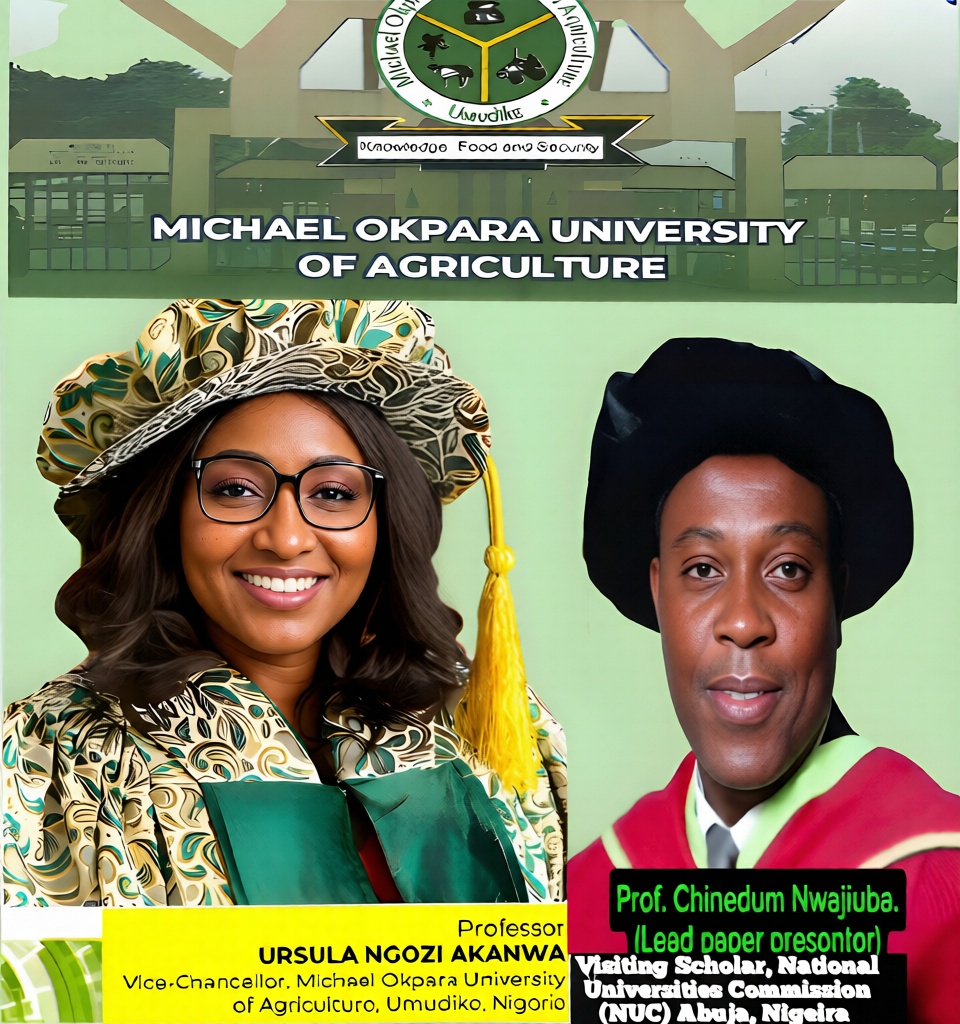
UMUDIKE, ABIA STATE — July 14, 2026
Nigeria’s drive toward climate-smart agriculture and digital farming will achieve limited results unless technological innovation is aligned with the real needs of farmers, Professor Chinedum Nwajiuba, renowned agricultural economist and former Vice-Chancellor of Alex Ekwueme Federal University, Ndufu-Alike (AE-FUNAI), has said.
Professor Nwajiuba made the assertion while delivering the lead paper at the 2nd International Conference of the College of Agricultural Economics, Rural Sociology and Extension (CAERSE) at Michael Okpara University of Agriculture, Umudike (MOUAU). He argued that Nigeria’s agricultural transformation depends not on adopting technology for its own sake, but on ensuring that innovation addresses productivity, affordability, resilience, and inclusion.
The conference, held at the university’s Centre for Entrepreneurship Development from July 14 to 15, is themed “Smart Agricultural Production, Green Growth and Sustainable Development in Nigeria.”
Presenting a paper titled “Smart This and Smart That: Locating the ‘Smart’ in Contemporary Agricultural Policy and Practice in Nigeria,” Nwajiuba noted that climate-smart agriculture, digital agriculture, green growth, and sustainable development have become dominant themes in Nigeria’s agricultural policy discourse. However, he warned that these concepts are increasingly being reduced to a technology-driven narrative.
According to him, technologies such as sensors, drones, artificial intelligence, and precision farming equipment are often automatically regarded as “smart,” even though true smartness should be measured by their ability to solve practical agricultural challenges. He maintained that technological sophistication is not the same as agricultural intelligence. Instead, he argued, smartness should be judged by measurable improvements in productivity, farmer incomes, climate resilience, resource efficiency, affordability, inclusion, and long-term sustainability.
Nwajiuba stressed that Nigeria should not reject advanced technologies. Rather, he said such technologies should be introduced and governed in ways that ensure they address critical agricultural and value-chain constraints instead of merely showcasing technical novelty.
The professor also commended the organisers of the conference and expressed appreciation to the College of Agricultural Economics, Extension and Rural Sociology for the invitation to present the lead paper. He praised the Vice-Chancellor and university management for sustaining the annual conference, describing it as an important platform for scholarly exchange, policy engagement, improved teaching, research, and community service.
Explaining the role of a lead paper, Nwajiuba said it should go beyond reporting a narrow experiment. Instead, it should clarify concepts, synthesise evidence, identify policy tensions, and frame questions capable of advancing research and public policy. He added that the conference theme provided an opportunity to interrogate prevailing assumptions surrounding smart agriculture and establish a practical agenda for research, policymaking, and implementation.
He noted that the word “smart” has become increasingly fashionable across sectors including education, energy, transport, health, and agriculture. However, he argued that the usefulness of the term depends on whether it improves analytical clarity or simply projects an image of modernity. The real challenge, he said, is determining whether smartness should be defined by the sophistication of a technology or by the quality, fairness, and sustainability of the outcomes it produces.
Nwajiuba observed that Nigeria relies heavily on agriculture to provide food, create employment, generate foreign exchange, supply industrial raw materials, and sustain rural livelihoods. Yet these expectations continue to be undermined by low productivity, post-harvest losses, weak logistics, poor market coordination, inadequate irrigation, limited extension services, insecurity, land-tenure challenges, and climate-related shocks. While climate-smart agriculture remains important, he cautioned that it must not be reduced to a mere catalogue of technologies.
The agricultural economist distinguished climate-smart agriculture from digital agriculture and precision agriculture, explaining that although the three fields overlap, they are not identical. Climate-smart agriculture, he said, seeks to sustainably increase productivity and incomes, strengthen adaptation and resilience, and reduce greenhouse gas emissions where feasible. Digital agriculture relies on data, connectivity, and software to support decision-making and service delivery, while precision agriculture focuses on improving accuracy through technologies such as sensors, drones, hydroponics, and automated greenhouses.
According to Nwajiuba, the key question should not be whether a farming practice is old or new, but whether it solves a clearly identified problem, delivers measurable benefits, remains affordable, and can be supported by the necessary infrastructure, financing, skills, extension services, and institutions. He pointed out that familiar practices such as adjusted planting dates, mixed cropping, improved crop varieties, soil and water conservation, agroforestry, composting, integrated pest management, and water harvesting can all be climate-smart when properly applied and evaluated.
At the same time, he acknowledged the potential value of advanced technologies such as automated machinery, satellite imagery, algorithm-based diagnostics, and networked sensors when their costs, reliability, and institutional suitability justify adoption. He referenced an indicative review of projects funded under the 2025 Tertiary Education Trust Fund (TETFund) National Research Fund, which showed growing interest in artificial intelligence, the Internet of Things (IoT), digital platforms, and climate-resilient agriculture.
The projects highlighted included AI-driven precision agriculture, intelligent irrigation systems, IoT-enabled storage facilities, smart greenhouses, blockchain-integrated farming systems, mobile-based soil fertility testing, and climate-smart disease management. He noted that agriculture accounted for 26 of the 109 projects within the relevant science and technology category, while 12 of the 26 agricultural projects explicitly referenced climate-smart agriculture, digital technologies, artificial intelligence, or IoT innovations.
However, he cautioned that these figures reflect project titles rather than evidence of successful adoption, measurable impact, or value for money. He identified six major barriers to the widespread adoption of advanced agricultural technologies in Nigeria: weak rural infrastructure, unreliable electricity, inadequate roads and irrigation, high ownership costs, limited access to finance, insufficient technical skills, weak extension systems, diverse agro-ecological conditions, social exclusion, and poor governance of agricultural data.
Nwajiuba argued that digital tools cannot compensate for every physical deficiency and maintained that investments in feeder roads, water management, storage facilities, and extension services would often produce greater and more inclusive returns than expensive digital technologies alone. He also emphasised the continued importance of extension agents, producer organisations, agro-dealers, and local service providers in translating information into practical farming decisions. Evidence from South-East Nigeria, he noted, shows that access to extension services, credit, education, and cooperative membership significantly influences the adoption of climate-smart agricultural practices.
He further warned that smartphone-only services, English-only interfaces, and collateral-based financing could deepen existing inequalities by excluding women, elderly farmers, remote communities, and individuals with limited literacy. To improve accessibility, he advocated greater use of voice services, radio broadcasts, USSD platforms, local languages, and gender-responsive approaches.
On data governance, Nwajiuba called for stronger safeguards around consent, privacy, ownership, cybersecurity, interoperability, and transparency. Farmers, he said, should clearly understand what information is being collected, how it will be used, and what benefits they can expect from sharing it.
To guide future investments, he proposed a contextual-smartness framework that would require policymakers to determine whether an intervention addresses a clearly identified constraint, produces measurable benefits, remains affordable, includes vulnerable groups, functions under local conditions, can be maintained locally, protects natural resources and farmer data, and can scale sustainably without permanent public subsidies.
The professor urged Nigeria to move beyond buzzwords and focus on practical policy actions. These include strengthening rural infrastructure, institutionalising farmer participation in technology design, modernising extension services, adopting evidence-based scaling strategies, tailoring interventions to different agro-ecological zones, promoting affordable digital innovation, aligning finance with proven technologies, and strengthening governance through transparent evaluation.
He stressed that these priorities do not oppose technology. Rather, they place innovation within a broader agricultural system where infrastructure, institutions, markets, ecological knowledge, and human capacity collectively determine success. He advocated low-cost digital innovations that function effectively on widely available devices, minimise energy and data requirements, and connect farmers to reliable information, markets, and essential services.
Nwajiuba also called for greater integration of indigenous knowledge with scientific research, arguing that local experience should complement rather than compete with science in improving agricultural relevance, trust, and adaptation.
Concluding his presentation, he maintained that Nigeria would discover the true meaning of smart agriculture only when research and public policy reward practical problem-solving, continuous learning, and sustained benefits for farmers rather than technological sophistication alone.
“Nigeria will locate the genuine ‘smart’ in agriculture when public policy and research reward problem-solving, learning and sustained farmer benefit rather than technological novelty alone. The measure of success is not how advanced an intervention appears, but whether it enables diverse producers and value-chain actors to achieve better, more resilient and environmentally responsible outcomes at a cost they and the country can sustain,” he said.