By Godson Azu
Introduction: Democracy at an Electoral Crossroads
As major elections approach across leading democracies — the United Kingdom’s May 2026 Local Council Elections, the United States Midterm Elections in November 2026, and the anticipated General Elections in Kenya and Nigeria in 2027 — politics has once again entered its familiar season of persuasion, promises, and political theatre.
Across continents, politicians have returned to the public square preaching renewed visions of hope, responsibility, and reform. Campaign speeches multiply, manifestos are rebranded, and ideological narratives are carefully reconstructed. Yet beneath the choreography of democratic competition lies a deeper and more uncomfortable question:
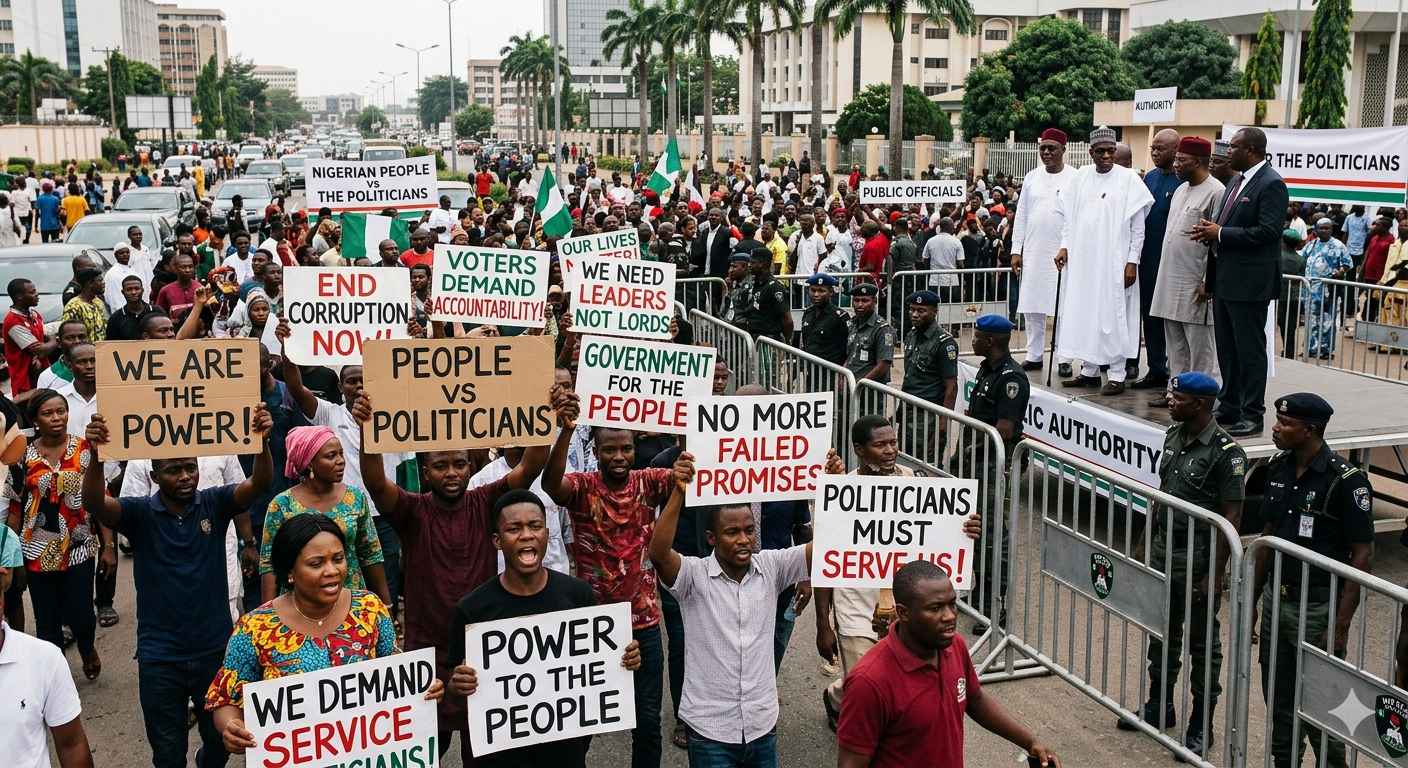
In modern democracy, who truly decides — the people or the politicians?
The Ritual of Political Promises
Election cycles often resemble political sermons. Leaders speak of transformation, renewal, and national destiny, while voters are invited once again to suspend disbelief.
In established democracies, political accountability still operates within institutional guardrails. Leaders defend ideological traditions, confront policy failures, and negotiate public scrutiny. The ongoing political debates surrounding figures such as former U.S. President Donald Trump and UK Prime Minister Keir Starmer illustrate how democratic systems compel leaders to justify governance choices before an informed electorate and an active institutional framework.
Even where polarization exists, democratic maturity ensures that institutions — courts, legislatures, media, and civil society — remain counterweights to executive ambition.
However, the dynamics shift dramatically when one moves from institutionalized democracies to fragile or transitional ones.
Developed Democracies: Accountability as Political Currency
In much of Europe and North America, political legitimacy increasingly depends on performance rather than rhetoric alone. Voters demand measurable outcomes:
• economic stability,
• social welfare delivery,
• immigration management,
• institutional transparency.
Failures are debated publicly, investigated institutionally, and punished electorally.
Political philosopher Karl Popper famously defined democracy not by who governs, but by whether citizens can peacefully remove bad leaders. Accountability, therefore, becomes democracy’s defining mechanism.
Developing Democracies: Politics as Spectacle
In many developing political systems, electoral politics assumes a different character. Campaign discourse often shifts from policy accountability to symbolic gestures:
• grand infrastructure announcements,
• sweeping economic reform declarations,
• populist redistribution promises,
• ethnic or patronage mobilization.
Politics becomes performative rather than programmatic.
The electorate is not merely persuaded; it is managed.
Economic hardship and institutional weakness create environments where political loyalty can be negotiated through material incentives rather than democratic conviction.
Nigeria: Democracy at a Dangerous Intersection
Nigeria presents perhaps one of the most complex democratic contradictions of the contemporary era.
Despite over two decades of uninterrupted civilian rule, several structural concerns persist:
- The Drift Toward Political Monopoly
Opposition fragmentation and elite political migration raise fears of a dominant-party environment, weakening competitive democracy.
- Electoral Institutional Trust Deficit
Public confidence in electoral administration fluctuates, with recurring allegations of manipulation and administrative opacity.
- A Judiciary Under Persistent Suspicion
Courts increasingly determine political outcomes, placing enormous pressure on judicial credibility. When electoral legitimacy depends more on litigation than ballots, democracy risks judicialization without trust.
- Politics as Economic Marketplace
Political participation often reflects financial capacity rather than ideological commitment. Elections risk becoming investments expecting returns rather than civic mandates.
The Politics of Poverty and Power
Perhaps Nigeria’s greatest democratic challenge is not constitutional design but socioeconomic reality.
A society marked by widespread poverty becomes vulnerable to political monetization. Votes transform into survival tools; citizenship risks becoming transactional.
Political theorist Jean-Jacques Rousseau warned:
“The people, once accustomed to masters, are no longer capable of living without them.”
Where economic insecurity dominates daily existence, democratic choice becomes constrained.
The question therefore emerges:
Can genuine democratic accountability exist in a deeply unequal society where poverty itself becomes a political weapon?
Who Really Decides?
The paradox of modern democracy lies here:
• Citizens vote.
• Politicians govern.
• Institutions interpret.
• Courts validate.
But decision-making power often concentrates within political elites long before ballots are cast — through party structures, candidate selection, campaign financing, and institutional influence.
Thus, elections sometimes ratify choices already shaped by political establishments.
This reality transforms democracy from popular sovereignty into managed legitimacy.
The Possibility of Democratic Reawakening
History demonstrates that democratic renewal often emerges when citizens redefine their political identity beyond patronage and fear.
Moments of democratic awakening share common features:
• civic consciousness,
• youth participation,
• institutional courage,
• independent media,
• principled judicial conduct.
Nigeria’s 2027 elections may therefore represent more than a routine political transition; they may test whether citizens can reclaim democratic ownership from entrenched political structures.
The future may depend on whether voters act as clients of politicians or custodians of democracy.
Responsibility and Accountability: A Two-Way Contract
Democracy imposes obligations not only on leaders but also on citizens.
Politicians must:
• govern transparently,
• respect institutions,
• accept accountability.
Citizens must:
• vote conscientiously,
• resist political commodification,
• defend democratic norms beyond election day.
As Abraham Lincoln reminded the world:
“Government of the people, by the people, for the people shall not perish from the earth.”
But such government survives only when the people insist upon it.
Conclusion: The Coming Democratic Test
The elections of 2026 and 2027 across the UK, United States, Kenya, and Nigeria will measure more than political popularity. They will test whether democracy remains a system of public accountability or has evolved into a managed competition among political elites.
Nigeria stands at a particularly critical juncture. The interplay of money politics, institutional vulnerability, and socioeconomic inequality presents both danger and opportunity.
The central question remains unresolved:
Will the people decide the future of democracy, or will politicians continue to decide on behalf of the people?
The answer may define not only Nigeria’s democratic trajectory but the credibility of democracy itself in the twenty-first century.
Godson Azu
UK-Based International Relations and Politics Expert, Analyst, Commentator and Adviser